
Driving Question
(Teacher Guided, Student Constructed)
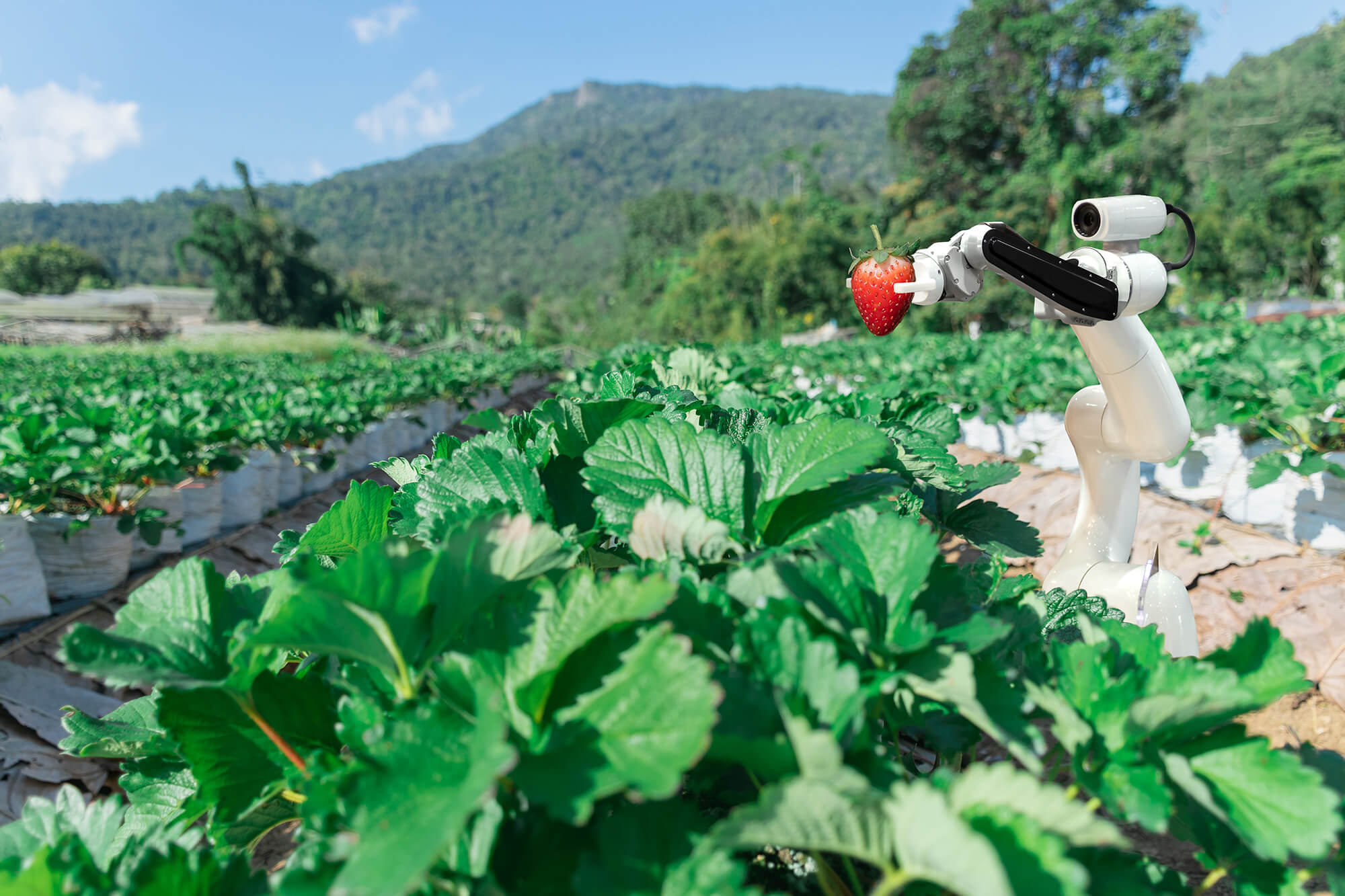
How can we decrease the need for manual farm laborers to grow and harvest our food supply?
Public Products
Students examine the manual labor needs of fruit and vegetable farms and present their findings and recommendations to an agricultural engineering company who will be contracted to design and build the prescribed robot/machine to perform the labor.
Connections
Foundations
Milestones
Milestone 1 (Day 1): Entry Event
Situation
Many food crops, especially fruits and vegetables, still require a great deal of manual labor to plant, grow, and harvest. It is difficult for farmers to secure a work force to perform the demanding manual labor required. Paying employee salaries is also a large business expense on a farm. In the role of an agricultural researcher, students examine the manual labor needs of fruit and vegetable farms and present their findings and recommendations to an agricultural engineering company who will be contracted to design and build the prescribed robot/machine to perform the labor.
Key Student Questions
- What are the biggest differences between farms from 100 years ago and farms today?
- What kind of labor is required to grow and harvest the food we eat?
Formative Assessments
- Quiz: Harvested by Hand or Machine?
Materials
- Harvested by Hand or Machine? Quizizz or Harvested by Hand or Machine? Kahoot!
- New Sunpreme Grape Variety from USDA-ARS Video (optional)
- How Does it Grow? Sheets, 1 copy per class
- project portfolio or folder, 1 per group
Instructional Procedures
- Instruct students to visualize in their minds two farms. The first farm produced food 100+ years ago, and the second farm is producing food today. Ask, “What do you imagine the biggest differences are between these two farms?” Allow students to offer their ideas. Whenever a student mentions technology (machinery, tractors, automation, etc.), emphasize their response.
- Have students take the introductory quiz, Harvested by Hand or Machine? Quizizz or Harvested by Hand or Machine? Kahoot! to evaluate their prior knowledge about how food is harvested.
- Following the quiz, have students share their thoughts. Ask students if there were more or less foods harvested by hand than they would have expected. Did they notice any patterns or correlations in the foods harvested by hand versus those harvested by machine? At the conclusion of your discussion, point out that the quiz focused only on the harvest of some of the foods we eat. If we look at the entire farm-to-fork process, we’d find many more steps that are performed by hand.
- Present the situation to the class: Many food crops, especially fruits and vegetables, still require a great deal of manual labor to plant, grow, and harvest. It is difficult for farmers to secure a work force to perform the demanding manual labor required. Paying employee salaries is also a large business expense on a farm.
- Guide the students to construct a question similar to, “How can we decrease the need for manual farm laborers to grow and harvest our food supply?”
- Introduce students to a career in research. Explain that researchers look for solutions to problems. They examine a problem from many angles, discover what is already known, and identify the knowledge that needs to be gained. Inform students that they will be taking on the role of an agricultural researcher to find the answer to their guiding question.
- Optional: To further illustrate the role of research in agriculture, show New Sunpreme Grape Variety from USDA-ARS Video. Point out that these researchers are looking for ways to decrease the labor to harvest grapes, increase resistance to a disease called Powdery Mildew, and to improve the overall quality of the grape. Similarly, students will be performing research to discover how to decrease manual labor in the production of our food.
- Divide the class into ten research teams. Explain to the teams that they will work in the role of an agricultural researcher to examine the manual labor needs of fruit and vegetable farms and present their findings and recommendations to an agricultural engineering company who will be contracted to design and build the prescribed robot/machine to perform the labor.
- Each team should select one fruit or vegetable crop to research throughout the PBL. You may use the How Does it Grow? Sheets for student groups to select from. Teams may pick from the ten fruit and vegetable crops included in the PDF, or they can choose their own crop using the blank template on the last page. If teams select their own crop, encourage them to choose fruits and vegetables found in the produce aisle at the grocery store. Teacher Tip: PBL experiences are enhanced when students can choose their own direction for their project. However, the experience will be most valuable if they pick a food crop that is primarily harvested manually rather than by machine. Determine ahead of time if you’d like each group to research a different crop or if they can duplicate crops.
- Have students use their How Does it Grow? Sheet to explore the entire farm-to-fork process of their fruit/vegetable crop to discover all of the labor requirements necessary to get their crop to the grocery store.
- On the sheets, there is a QR code for a How Does it Grow? episode that will give students a good start on their research.
- Students will need to research further. Be sure students are searching for information applicable to a commercial farm, not a backyard garden.
- At the conclusion of this milestone, students should have a general knowledge of their crop’s farm-to-fork process, recognize the steps in the process that have already been mechanized, identify steps that are performed manually, and have an idea of the job profiles of workers on the farm (seasons worked, hours worked in a day, working conditions, physical labor requirements, etc.).
- Teams should add their completed How Does it Grow? Sheet to their project portfolio or folder.
Comments (0)